# Overview
# Directories
There are several projects involved in the concept of Cinco Cloud that can be found in the repository. Here you see a quick overview of all the directories and their relations:
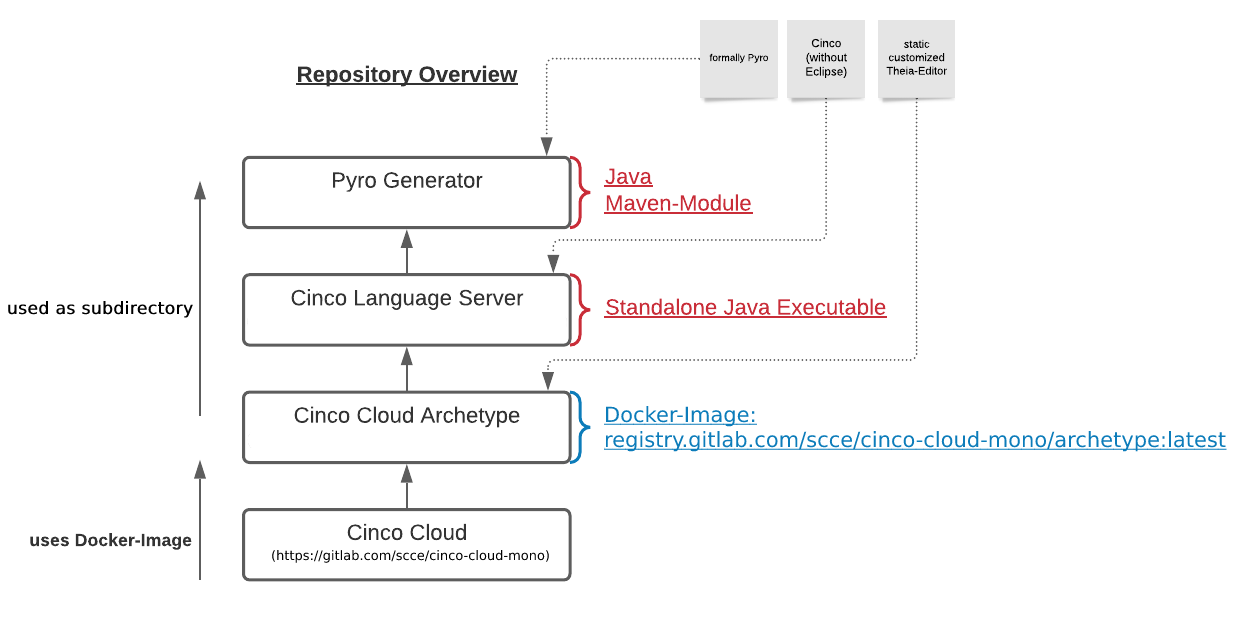
Cinco Cloud (opens new window): The cinco-cloud directory contains the main-app, which orchestrates the image deployment of editors and functions as central administration instances for the user- and project management.
Cinco Cloud Archetype (opens new window): The cinco-cloud-archetype directory holds the sources for the static editor, which is based on Eclipse Theia, including all theia and visual-studio-code based extensions. One of these extensions can execute the Cinco Language Server, thus the project also contains the Cinco Language Server-project as a sub-directory. Since this directory represents the most basic deployable Editor for a Cinco-Cloud project, it is continuously built to a docker-image via a CICD pipeline and put into a docker registry (registry.gitlab.com/scce/cinco-projects/cinco-editor/cinco-editor:latest). This image will be reused and further expressed for new Cinco Cloud projects.
Cinco Language Server (opens new window): The cinco-language-server itself is a standalone Java executable. It serves language support for the Cinco Languages (CPD, MGL, Style/MSL) and a Generator to express new Cinco Cloud Projects based on these languages. A great part of this project is based on the Cinco-repository, but without the Eclipse-IDE dependencies.
Pyro Generator (opens new window): The pyro-generator is a sub-directory for the Cinco Language Server. It expresses Cinco Cloud Projects based on the Cinco Languages. It is based on the formally known Pyro-repository.
# Architecture
# Services
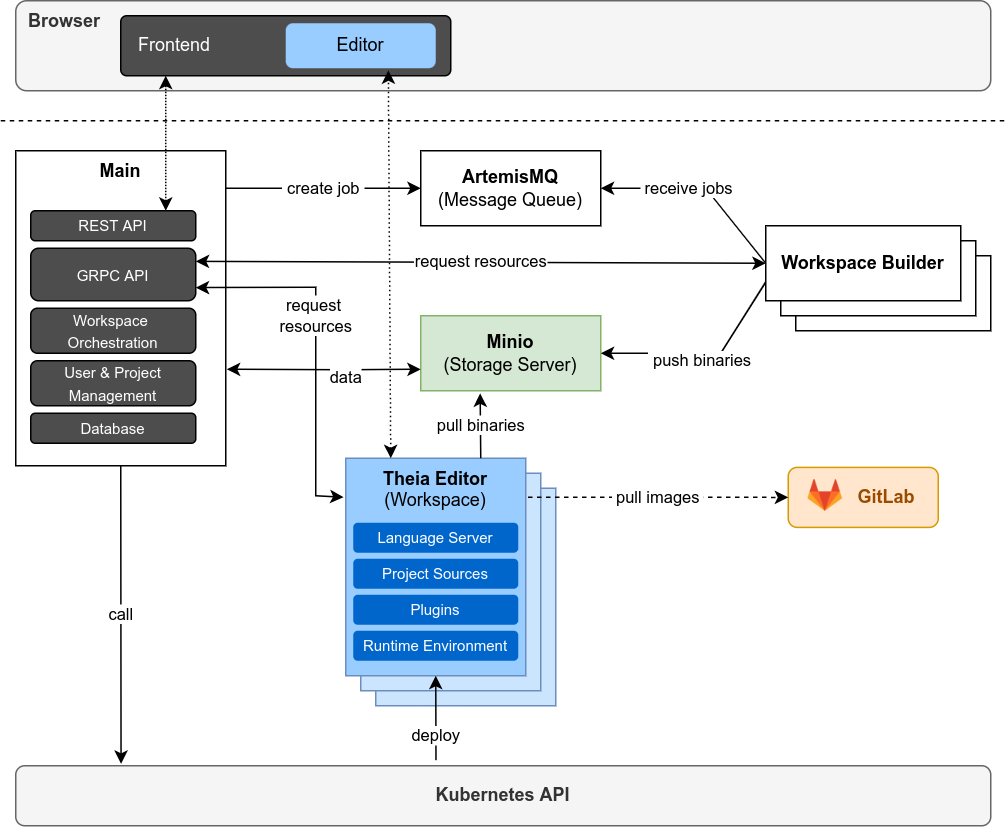
In the following, you can find a list of services that CincoCloud is composed of.
Main Service Forked from the Pyro code base, the main service is composed of a Postgres database, a Quarkus (opens new window) backend and an AngularDart (opens new window) frontend that are connected through a RESTful API. The service can be understood as the orchestrator of the displayed service landscape. State is stored and managed soley in the database of the Main Service, other services can request and manipulate data through a GRPC (opens new window) interface that is exposed. Further, the service is connected to the Kubernetes API of the cluster which is used for the orchestration of workspaces, i.e. it handles the creation and the garbage collection of inactive workspaces.
Theia Editor The Theia Editor is a framework for IDEs, based on Eclipse Theia (opens new window). It represents the artifact that can be deployed by the Kubernetes API. Its most basic form for the Cinco-Cloud, without specialization for a language, can be found inside the Cinco Cloud Archetype (opens new window). Each project that is deployed by a user via the CincoCloud frontend corresponds to exactly one Theia-based workspace. There are two kinds of editors that can be deployed: for the meta-level, a Language Editor is deployed that behaves similar to Cinco in a sense that we can define our graphical languages and write our generators here. The other one is a concrete Model Editor that uses parts of the Pyro front- and backend and allows graphical modelling. In contrast to the language editor, the model editor is deployed together with an additional database, where graphical models are persisted in a serialized form.
# Secrets
We need to have the following secrets (see the instruction on how to create and apply them here) in the cluster:
cinco-cloud-main-secrets
Secrets as key value pairs that are used by different services. It contains the secret that is used to hash user passwords and various encoded credentials for e.g. the database and Minio. The secret is of typeopaque.
# Collaboration Protocol
Cinco Cloud versions modeling projects with Git. A custom merge driver for lazy merging (opens new window) extends Git for structured and conflict-tolerant merging of model files. First-class conflicts within models mean that resolutions can be deferred, and conflicts can be shared via Git to be resolved collaboratively. Models can be edited normally in the presence of conflicts, so that users can wait for all necessary information to make good resolution decisions.
Participants can also share a remote workspace for collaborative modeling. Edits are recorded in the model file as a single source of truth and propagated to all editing sessions, enabling live collaboration.
# Legacy Pyro Collaboration Protocol
The following illustration documents the previous live collaboration protocol of Pyro, which was removed during the migration to Eclipse GLSP/Eclipse Theia and Git-based lazy merging. It is no longer part of Cinco Cloud.
